
If you’re wondering how to read a tape measure in inches, it’s simpler than you might think! A tape measure is marked with lines representing inches, and these inches are further divided into smaller fractions. Let’s break down how to decipher these tape measure markings to get accurate measurements.
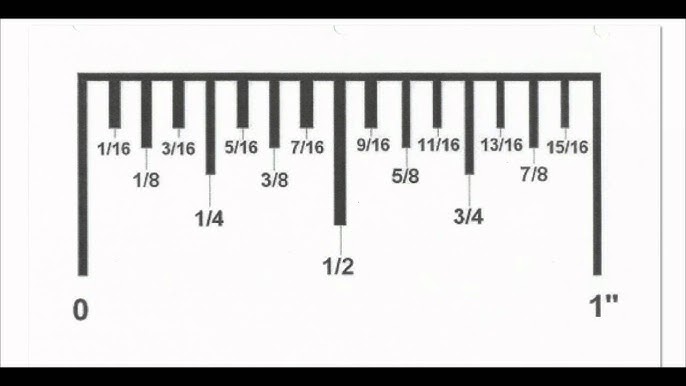
Image Source: i.ytimg.com
The Basics of Inch Markings
A standard tape measure is a fantastic tool for measuring length. In the United States and a few other countries, we primarily use the imperial system for measurements. This system relies on units like feet, inches, and fractions of an inch.
The Full Inch Mark
The most prominent markings on a tape measure represent whole inches. These are usually the longest lines and are often accompanied by numbers. If you see a “1,” “2,” “3,” and so on, these signify 1 inch, 2 inches, 3 inches, etc.
The Smallest Inch Increment
Most tape measures divide each inch into smaller segments. The most common division is into 16 parts, creating markings for 1/16 of an inch. You’ll also commonly see markings for 1/8, 1/4, and 1/2 inches. Knowing the smallest inch increment is crucial for precise work.
Deciphering the Lines: A Hierarchy of Marks
To effectively read a tape measure, you need to recognize the different lengths of the lines and what they represent. There’s a clear hierarchy:
- Longest lines (with numbers): These are your whole inches. They mark every foot (12 inches) and also every inch within that foot.
- Next longest lines: These typically represent the half-inch marks (1/2″). You’ll see one of these between each whole inch.
- Medium-length lines: These usually mark the quarter-inch points (1/4″ and 3/4″). There are two of these between each half-inch mark.
- Shorter lines: These represent the eighth-inch marks (1/8″, 3/8″, 5/8″, 7/8″). There are three of these between each quarter-inch mark.
- Shortest, most frequent lines: These are the 1/16th-inch marks. They are the smallest divisions and appear between every eighth-inch mark.
Visualizing the Fractions
It’s helpful to visualize how these fractions build upon each other.
- 1/16th: The absolute smallest division.
- 2/16ths: This simplifies to 1/8th.
- 3/16ths: This stays as 3/16ths.
- 4/16ths: This simplifies to 2/8ths, which further simplifies to 1/4th.
- 5/16ths: This stays as 5/16ths.
- 6/16ths: This simplifies to 3/8ths.
- 7/16ths: This stays as 7/16ths.
- 8/16ths: This simplifies to 4/8ths, which further simplifies to 2/4ths, which finally simplifies to 1/2.
- 9/16ths: This stays as 9/16ths.
- 10/16ths: This simplifies to 5/8ths.
- 11/16ths: This stays as 11/16ths.
- 12/16ths: This simplifies to 6/8ths, which further simplifies to 3/4ths.
- 13/16ths: This stays as 13/16ths.
- 14/16ths: This simplifies to 7/8ths.
- 15/16ths: This stays as 15/16ths.
- 16/16ths: This simplifies to 1 whole inch.
Grasping Tape Measure Scales
When you first look at a tape measure, the sheer number of lines can be a bit overwhelming. However, by recognizing the pattern of line lengths, you can quickly determine what each mark signifies. The key is to start with the largest, most obvious marks (the whole inches) and then move to the smaller divisions.
How to Read a Tape Measure: Step-by-Step
Let’s walk through the process of measuring inches and fractions with your tape measure.
Step 1: Identify the Starting Point
Your tape measure likely has a hook at the end. This hook is designed to catch onto edges. For most measurements, you’ll place the very tip of this hook at the beginning of the object you want to measure. The start of the measurement is the zero point.
Step 2: Extend the Tape Measure
Carefully pull the tape out to the end of the object you are measuring. Keep the tape straight and taut. Avoid letting it sag or twist.
Step 3: Locate the Nearest Whole Inch Mark
Find the last full inch mark that is before or at the end of your object. For example, if your object ends just past the 5-inch mark, your measurement starts with “5 inches.”
Step 4: Measure the Fraction of the Inch
Now, look at the space between the last whole inch mark (in our example, the 5-inch mark) and the end of your object.
- Check for the 1/2 inch mark: Is the end of your object at the longer line between the 5 and 6-inch marks? If so, your measurement is 5 and 1/2 inches.
- Check for 1/4 or 3/4 inch marks: If it’s not at the 1/2 inch mark, look for the next longest lines, which are the 1/4 and 3/4 inch marks. Is it at the first of these (5 and 1/4 inches)? Or the second (5 and 3/4 inches)?
- Check for 1/8 inch marks: If it’s not at a quarter-inch mark, look at the medium-length lines. These are your eighth-inch marks (5 and 1/8, 5 and 2/8 (which is 1/4), 5 and 3/8, 5 and 4/8 (which is 1/2), 5 and 5/8, 5 and 6/8 (which is 3/4), 5 and 7/8).
- Check for 1/16 inch marks: For the most precise measurements, look at the shortest lines. These are your 1/16th-inch marks. You’ll count these between the eighth-inch marks. For example, if your object ends at the third mark past the 5-inch line, and assuming the first mark is 1/16, the second is 2/16 (1/8), the third is 3/16, your measurement would be 5 and 3/16 inches.
Example Scenario: Measuring 5 and 7/8 Inches
Let’s say you’re measuring a piece of wood, and the end of the wood falls between the 5-inch mark and the 6-inch mark.
- You see the 5-inch mark clearly. This is your whole number.
- Between the 5 and 6-inch marks, you look for the longest line after 5, which is the 1/2 inch mark (5 and 1/2). Your wood ends after this.
- You then look for the next longest lines, the 1/4 and 3/4 marks. Your wood ends after the 1/2 inch mark but before the 3/4 inch mark.
- Now you look at the medium-length lines, which represent eighths. You count:
- 5 and 1/8
- 5 and 2/8 (which is 5 and 1/4)
- 5 and 3/8
- 5 and 4/8 (which is 5 and 1/2)
- 5 and 5/8
- 5 and 6/8 (which is 5 and 3/4)
- 5 and 7/8
If the end of your wood lines up with the 5 and 7/8 inch mark, that’s your measurement.
Using a Reference Table for Clarity
To help with reading imperial units, here’s a quick reference table showing the fraction names and their corresponding sixteenth-inch equivalents:
| Fraction | Sixteenths Equivalent |
|---|---|
| 1/2 | 8/16 |
| 1/4 | 4/16 |
| 3/4 | 12/16 |
| 1/8 | 2/16 |
| 3/8 | 6/16 |
| 5/8 | 10/16 |
| 7/8 | 14/16 |
| 1/16 | 1/16 |
| 3/16 | 3/16 |
| 5/16 | 5/16 |
| 7/16 | 7/16 |
| 9/16 | 9/16 |
| 11/16 | 11/16 |
| 13/16 | 13/16 |
| 15/16 | 15/16 |
Interpreting Tape Measure Scales: Beyond the Basics
Some tape measures have additional markings that can be helpful for specific tasks.
The 16-Inch and 19.2-Inch Marks
Many construction tape measures feature special markings at 16 inches and sometimes 19.2 inches. These are standard stud spacing measurements in framing. If you see a different colored mark or a slightly bolder line at these points, it’s a reminder of these common building intervals.
The Black Diamond Marks
You might notice black diamond shapes on some tape measures. These typically appear every 19.2 inches. This spacing is used in some types of construction for rafters and trusses.
Feet Markings
While we are focusing on inches, most tape measures also clearly indicate feet. Usually, feet are marked with a larger, bolder number (like “1”, “2”, “3” for 1 foot, 2 feet, 3 feet). Remember that 1 foot equals 12 inches. So, the 12-inch mark on your tape measure is also the 1-foot mark.
Calibrating a Tape Measure: Ensuring Accuracy
Before you start any important project, it’s a good idea to check your tape measure’s tape measure accuracy. While generally reliable, extreme temperatures or heavy use can affect them.
The Hook Test
- Place the end hook of your tape measure firmly against a solid edge, like a workbench or wall.
- Extend the tape measure to a point you can easily read, like a clear 12-inch mark or 1-foot mark.
- Make sure the tape is perfectly straight and not bending.
- If the tape measure is accurate, the 12-inch mark (or 1-foot mark) on the tape should align perfectly with the end of the object you are measuring against.
- If there’s a slight gap or overlap at the 12-inch mark, it indicates a potential inaccuracy in the tape. Most tape measures are designed so the hook can slide slightly to compensate for this.
Using a Known Length
Another method is to measure an object whose length you already know precisely. For instance, if you have a perfectly straight 3-foot ruler, measure it with your tape measure. If the tape measure reads exactly 36 inches, it’s likely accurate.
Converting Tape Measure Readings
Sometimes, you might need to convert measurements.
Inches to Feet and Inches
To convert a total number of inches into feet and inches:
- Divide the total number of inches by 12 (since there are 12 inches in a foot).
- The whole number part of the result is the number of feet.
- The remainder is the number of inches.
Example: You measured 45 inches.
45 divided by 12 is 3 with a remainder of 9. So, 45 inches is 3 feet and 9 inches.
Fractions to Decimals
For some digital tools or calculations, you might need to convert fractions to decimals.
- 1/2 = 0.5
- 1/4 = 0.25
- 3/4 = 0.75
- 1/8 = 0.125
- 3/8 = 0.375
- 5/8 = 0.625
- 7/8 = 0.875
- 1/16 = 0.0625
Example: Measuring 5 and 3/8 inches.
This is 5 inches + 3/8 inches.
3/8 inches as a decimal is 0.375.
So, the measurement is 5.375 inches.
Common Mistakes When Reading a Tape Measure
Even with clear instructions, a few common pitfalls can lead to incorrect measurements.
Not Keeping the Tape Straight
A sagging or bent tape measure will always give a shorter, inaccurate reading. Always ensure the tape is pulled taut and follows a straight line.
Miscounting the Small Marks
When you get down to the 1/16th or even 1/32nd marks (on some specialized tapes), it’s easy to miscount. Double-check your counting, especially for critical measurements.
Not Using the Hook Correctly
For inside measurements (like measuring the width of a doorway), remember that the hook’s thickness is accounted for in the measurement. The hook slides outward when you pull the tape. For outside measurements, ensure the hook is firmly against the edge.
Overlooking the Smallest Increment
If your project requires precision, don’t just round to the nearest quarter or eighth inch if you can read the 16th. Always use the smallest increment needed for the job.
Using a Damaged Tape Measure
If your tape measure is bent, creased, or the markings are faded, it’s time for a new one to ensure tape measure accuracy.
Frequently Asked Questions (FAQ)
Q1: What is the difference between the lines on a tape measure?
The lines on a tape measure represent different fractions of an inch. Longer lines usually indicate larger fractions (like 1/2 or 1/4), while shorter lines represent smaller fractions (like 1/8 or 1/16). The numbered lines are whole inches.
Q2: How do I read measurements that are not on a whole inch mark?
To read measurements between whole inches, identify the last whole inch mark before your measurement point. Then, count the smaller lines from that whole inch mark to your measurement point. For example, if your measurement ends at the third shortest line after the 7-inch mark, and the smallest increment is 1/16th, your measurement is 7 and 3/16 inches.
Q3: Can I measure in feet and inches simultaneously on a tape measure?
Yes. Most tape measures show both inches and feet. The 12-inch mark is also the 1-foot mark, the 24-inch mark is the 2-foot mark, and so on. You’ll often see larger numbers or red markings at these foot intervals.
Q4: How do I measure something that is shorter than an inch?
If the object is shorter than an inch, you’ll focus on the segment between the start of the tape (the hook) and the end of the object. You’ll read the fraction of the inch represented by the mark closest to the object’s end. For example, if it ends at the second shortest line and the smallest increment is 1/16th, it’s 2/16th or 1/8th of an inch.
Q5: Why are there different line lengths on a tape measure?
The different line lengths are a visual shorthand to help you quickly identify the value of the fractional measurements. Longer lines represent larger fractions, making it easier to read common measurements like half-inches and quarter-inches at a glance.
Conclusion
Mastering how to read a tape measure in inches is a fundamental skill for anyone involved in DIY projects, construction, crafts, or even just everyday tasks. By familiarizing yourself with the tape measure markings, understanding the hierarchy of inch marks, and practicing the step-by-step process, you can confidently take accurate measurements. Always remember to keep your tape measure straight, count carefully, and check its tape measure accuracy to ensure your projects turn out just right. Happy measuring!