
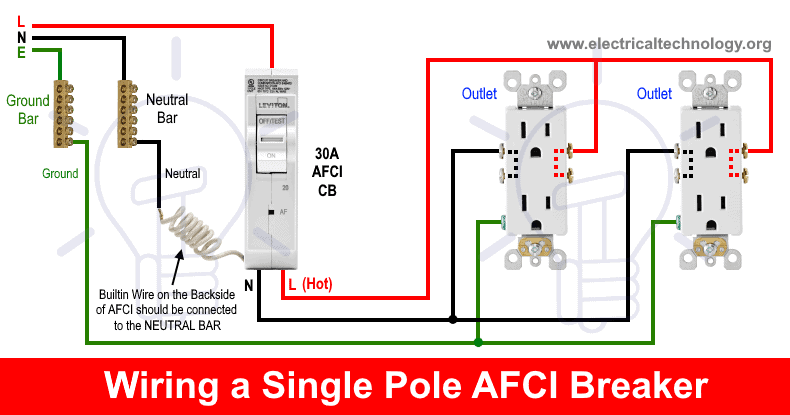
Image Source: www.electricaltechnology.org
How To Install AFCI Circuit Breaker Safely: Step-by-Step Guide
Can I install an AFCI circuit breaker myself? Yes, if you have a good grasp of basic electrical work and follow safety precautions diligently. Who should install an AFCI circuit breaker? While DIY installation is possible for those with electrical experience, it’s always safest to hire a qualified electrician, especially if you’re unsure about any step. This guide provides a detailed walkthrough for AFCI breaker installation, but remember that electrical work carries inherent risks. Always prioritize safety and consult a professional if you have any doubts.
Deciphering AFCI Technology: Protecting Your Home from Arc Faults
AFCI stands for Arc Fault Circuit Interrupter. It’s a vital safety device designed to protect your home and family from electrical fires caused by arcing faults. Unlike standard circuit breakers that trip only when there’s an overcurrent (too much electricity flowing), AFCI breakers can detect and interrupt the dangerous arcing that occurs when electrical wires are damaged or connections become loose. This arcing can generate significant heat, igniting nearby combustible materials like insulation or wood framing.
What is an Arc Fault?
An arc fault is an unintended electrical discharge between two or more conductors. Think of it like a tiny, uncontrolled lightning bolt happening within your walls. These arcs can be caused by:
- Damaged wires: Frayed insulation, pinched wires, or damaged cord sets.
- Loose connections: In outlets, switches, junction boxes, or at the breaker panel itself.
- Cord damage: Pets chewing on cords, furniture pinching them, or general wear and tear.
- Improperly installed wiring: Over time, vibrations or shifting can loosen connections.
AFCI vs. GFCI Breakers: Knowing the Difference
It’s common to confuse AFCI and GFCI (Ground Fault Circuit Interrupter) breakers, but they serve different purposes.
| Feature | AFCI Breaker | GFCI Breaker |
|---|---|---|
| Primary Function | Detects and interrupts arcing faults. | Detects and interrupts ground faults. |
| Protection Against | Electrical fires caused by arcing. | Electrical shock from current leakage to ground. |
| How it Works | Monitors electrical waveforms for characteristic arc patterns. | Monitors the balance of current flowing out and returning. |
| Common Applications | Bedrooms, living rooms, general living areas (required by code). | Bathrooms, kitchens, garages, outdoor outlets, areas near water. |
| Tripping Causes | Arcing faults, but can sometimes trip due to electronics or certain power tools. | Current leakage to ground, moisture, faulty appliances. |
While GFCI breakers protect you from electric shock, AFCI breakers are specifically designed to prevent fires. Many modern codes require AFCI protection in most living areas of a home, making AFCI breaker replacement an important safety upgrade.
Why Install AFCI Breakers? Code Requirements and Safety Benefits
The National Electrical Code (NEC) mandates AFCI protection in many areas of new construction and often requires it for renovations. These AFCI breaker code requirements are in place to significantly reduce the risk of electrical fires.
Key safety benefits of installing AFCI breakers include:
- Fire Prevention: The primary benefit is preventing fires caused by arc faults.
- Enhanced Safety: Offers a higher level of protection than standard breakers.
- Code Compliance: Ensures your home meets current safety standards.
- Peace of Mind: Knowing your home is better protected against electrical hazards.
Preparing for AFCI Breaker Installation: Tools and Safety First
Before you begin any AFCI circuit breaker installation, gather the necessary tools and, most importantly, prioritize your safety.
Essential Tools for AFCI Breaker Installation:
- Voltage Tester (Non-contact and Contact): Crucial for confirming power is off.
- Screwdrivers: Phillips and flathead, in various sizes.
- Wire Strippers/Cutters: For preparing wires.
- Pliers (Needle-nose and Lineman’s): For bending and gripping wires.
- Wire Brush: For cleaning bus bars in the panel.
- Flashlight or Headlamp: For illumination in the panel.
- Safety Glasses: To protect your eyes.
- Insulated Gloves: For an extra layer of protection.
- A Step Ladder: If needed to reach the breaker panel.
- AFCI Circuit Breaker: Ensure it’s the correct type and amperage for your panel and circuit.
Safety Precautions: The Golden Rules
- TURN OFF THE MAIN POWER: This is the most critical step. Locate your main electrical panel and switch off the main breaker that controls all power to your home. Verify that all power is off using your voltage tester on multiple circuits and the main lugs.
- Never Work on a Live Panel: This is incredibly dangerous and can lead to electrocution or severe injury.
- Wear Safety Gear: Always wear safety glasses and, ideally, insulated electrical gloves.
- Keep the Work Area Dry: Never work on electrical systems in wet conditions.
- Know Your Panel: Familiarize yourself with your specific breaker panel.
- If in Doubt, Call a Professional: Electrical work can be hazardous. If you’re not comfortable or sure about any step, hire a licensed electrician.
AFCI Circuit Breaker Wiring Diagram: How to Wire an AFCI Breaker
The wiring for an AFCI breaker is slightly different from a standard breaker. The key difference is the need to connect the “pigtail” wire (often a short piece of black wire with a loop at the end) from the AFCI breaker to the neutral bus bar in your panel.
Here’s a general breakdown of how to wire an AFCI breaker:
1. Disconnect Power: As emphasized before, ensure the main power to your home is OFF and verified.
2. Open the Panel: Carefully remove the cover of your electrical breaker panel.
3. Locate the Old Breaker: Identify the circuit breaker you are replacing.
4. Disconnect the Old Breaker:
* Remove the wire: Loosen the screw on the breaker terminal and remove the hot (usually black) wire.
* Release the breaker: Most breakers clip onto the bus bar. Gently pull the breaker away from the bus bar and then unclip it from the panel’s mounting rail.
5. Prepare the New AFCI Breaker:
* Identify the wires: Your AFCI breaker will have a hot wire that connects to the breaker itself and a pigtail wire (usually white or gray) that needs to connect to the neutral bus bar.
* Secure the pigtail: Many AFCI breakers come with the pigtail wire attached. If not, you may need to attach it according to the manufacturer’s instructions. This pigtail is crucial for the breaker’s internal electronics.
6. Connect the AFCI Breaker:
* Install the breaker: Clip the new AFCI breaker onto the bus bar in the vacant spot (or the spot you removed the old breaker from). Ensure it snaps firmly into place.
* Connect the pigtail: Secure the pigtail wire from the AFCI breaker to an available terminal on the neutral bus bar. You might need to loosen a screw, insert the wire, and then tighten the screw firmly.
* Connect the hot wire: Connect the hot wire from your circuit (the one that was connected to the old breaker) to the terminal screw on the new AFCI breaker. Tighten the screw securely.
7. Double-Check Connections: Ensure all wires are properly stripped and all screws are tight. Loose connections are a major safety hazard.
8. Replace the Panel Cover: Once all connections are secure, carefully replace the breaker panel cover.
9. Restore Power and Test:
* Turn on the main breaker: Restore power to your home.
* Test the AFCI breaker: Most AFCI breakers have a “test” button. Press it. The breaker should trip, indicating it’s working. If it doesn’t trip, or if other breakers trip, immediately turn off the main power and re-check your wiring.
* Test the circuit: Turn on the AFCI breaker. Then, go to the outlet or device on that circuit and ensure it’s functioning correctly.
AFCI Circuit Breaker Wiring Diagram Example
While the specifics can vary slightly by manufacturer, here’s a simplified visual representation to help you grasp the AFCI circuit breaker wiring diagram:
_______________________________________ | | | [MAIN PANEL] | | | | _______________________ | | | AFCI BREAKER | | | | | | | | [ ] HOT WIRE —> [ ] TERMINAL | | | | | | | [O] PIGTAIL —> [O] NEUTRAL BUS | | | (WHITE/GRAY) (BAR) | | |_______________________| | | | | _______________________ | | | CIRCUIT WIRES | | | | | | | | [ ] HOT (BLACK) —-> [ ] TERMINAL | | | [ ] NEUTRAL (WHITE) -> NEUTRAL BUS | | | [ ] GROUND (GREEN/BARE) -> GROUND BUS| | |_______________________| | |_______________________________________|
- HOT WIRE (from circuit): Connects to the screw terminal on the AFCI breaker.
- PIGTAIL (from AFCI breaker): Connects to a terminal on the neutral bus bar.
- NEUTRAL BUS BAR: Receives the pigtail wire from the AFCI breaker and all the neutral wires from your circuits.
- GROUND BUS BAR: Receives all ground wires from your circuits.
AFCI Breaker Replacement: A Common Upgrade
DIY AFCI breaker replacement is a very common electrical upgrade. As homes age, or as building codes are updated, replacing standard breakers with AFCI breakers is a sensible step to enhance safety. The process is largely the same as a new installation, focusing on removing the old standard breaker and installing the AFCI one.
Troubleshooting Common AFCI Breaker Tripping Causes
Even with correct installation, AFCI breakers can sometimes trip unexpectedly. It’s important to know the common AFCI breaker tripping causes to differentiate between a fault and nuisance tripping.
- Actual Arc Faults: This is the intended function. If the breaker trips repeatedly, it indicates a genuine problem in the circuit that needs professional investigation.
- Electronic Devices: Some electronic devices, especially those with motors or power supplies that create “noisy” waveforms, can sometimes cause AFCI breakers to trip. This is known as nuisance tripping.
- Solutions:
- Test individual devices: Unplug all devices on the circuit and see if the breaker still trips. Plug them back in one by one to identify the culprit.
- Relocate sensitive electronics: Try moving devices that cause nuisance tripping to a different circuit.
- Consider a different type of AFCI: Some newer AFCI breakers are designed to be more tolerant of electronic noise.
- Solutions:
- Overloaded Circuits: While standard breakers are designed to trip on overloads, an AFCI breaker might trip if the overload is severe enough to cause arcing.
- Faulty Appliances: A malfunctioning appliance can create arcing or ground faults, leading to a trip.
- Loose Connections: Even after installation, loose connections in outlets, switches, or even within the breaker panel can lead to arcing and tripping.
- Incorrect Installation: A common cause of persistent tripping is an improper connection, particularly with the neutral pigtail.
Advanced: Smart AFCI Breaker Installation
For those looking for enhanced control and monitoring, smart AFCI breaker installation offers additional features. These breakers connect to your home’s Wi-Fi network, allowing you to:
- Monitor circuit status remotely: Check if a breaker is tripped or on from your smartphone.
- Receive notifications: Get alerts if a breaker trips.
- Control circuits remotely: In some cases, you can remotely reset or switch circuits off.
The installation process for a smart AFCI breaker is similar to a standard AFCI, but it may involve additional steps for connecting to your home network, usually through a mobile app. Always follow the manufacturer’s specific instructions for smart AFCI breakers.
Testing Your AFCI Breaker: Ensuring Functionality
Regularly performing an AFCI breaker test is crucial to ensure it’s functioning correctly.
How to Perform an AFCI Breaker Test:
- Ensure the circuit is powered on.
- Locate the “Test” button on the AFCI breaker.
- Press the “Test” button firmly.
- The breaker should trip, shutting off power to the circuit.
- To reset, flip the breaker completely off (past the tripped position) and then back on.
Important: If the breaker doesn’t trip, or if it trips the main breaker or other circuits, immediately turn off the main power and have the breaker or your electrical system inspected by a qualified electrician. It’s also a good idea to test the circuit afterward by plugging in a small appliance or lamp.
Frequently Asked Questions (FAQ) about AFCI Breakers
Q1: Do AFCI breakers protect against electric shock?
A1: No, AFCI breakers protect against fires caused by arc faults. GFCI breakers are designed to protect against electric shock. Many modern installations use dual-function AFCI/GFCI breakers.
Q2: Can I replace a standard breaker with an AFCI breaker?
A2: Yes, in most cases, you can replace a standard breaker with an appropriately rated AFCI breaker, provided your panel can accept them and you follow proper wiring procedures.
Q3: How often should I test my AFCI breakers?
A3: It’s recommended to test AFCI breakers monthly.
Q4: What if my AFCI breaker trips frequently?
A4: Frequent tripping indicates a potential problem. It could be a genuine arc fault, a faulty appliance, a loose connection, or nuisance tripping from certain electronics. Try to identify the cause by unplugging devices or consult a qualified electrician.
Q5: Are AFCI breakers required in all rooms?
A5: National Electrical Code requirements vary, but they are typically mandated for living areas like bedrooms, living rooms, hallways, dining rooms, and sometimes kitchens and laundry areas. Local building codes may have additional requirements.
Q6: Is AFCI breaker installation difficult?
A6: For someone with basic electrical knowledge and the right tools, AFCI breaker installation is manageable. However, if you’re not comfortable working inside an electrical panel, it’s always best to hire a professional electrician.
Q7: What is the difference in wiring between AFCI and GFCI breakers?
A7: Both have a connection to the neutral bus bar, but the function of that connection differs. An AFCI’s connection is for its internal electronics to monitor the waveform, while a GFCI’s connection is part of the current-sensing mechanism.
By following this comprehensive guide, you can confidently approach AFCI breaker installation and replacement, enhancing the safety of your home against electrical fires. Remember, safety is paramount, and when in doubt, always call a professional electrician.