
What if you need to measure something, but your trusty tape measure is nowhere to be found? Can you still get accurate measurements? Yes, you can! This guide will show you smart ways to measure using common items and simple techniques.
Many of us have been there. You’re in the middle of a DIY project, hanging a picture, or trying to figure out if that new sofa will fit through the door, and you realize your tape measure is missing. Panic might set in, but don’t worry! You don’t always need a specialized tool to get a good idea of size and distance. Nature and our own homes provide plenty of resources for clever measurement.
This post will explore various methods, from using your body parts and common household items to more practical techniques like pacing and using string length. We’ll break down how to make accurate estimations and use visual comparison, even without a tape measure.
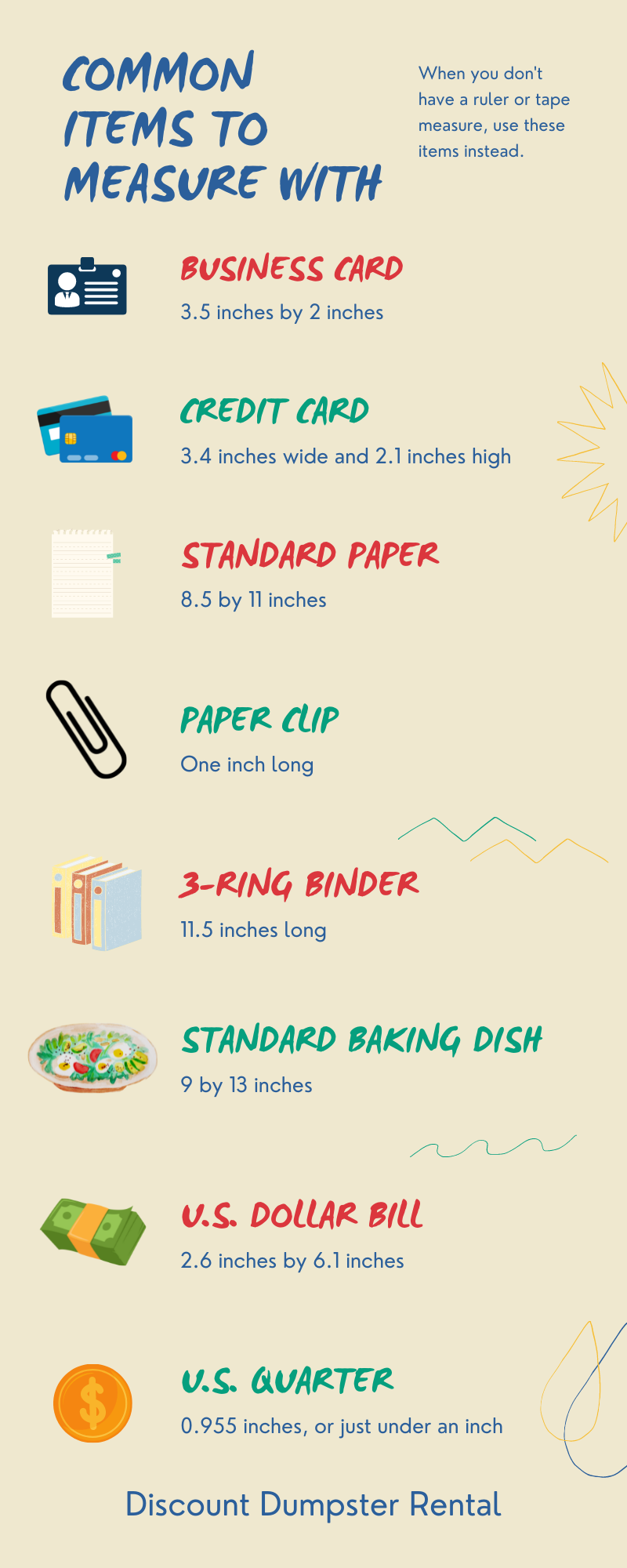
Image Source: discountdumpsterco.com
Measuring with Your Body Parts: The Original Tools
Your own body is a surprisingly accurate measuring tool! For centuries, people relied on their limbs and digits for all sorts of measurements. While not as precise as a tape measure, these methods are excellent for general estimations and quick checks.
The Hand Span
The distance from the tip of your thumb to the tip of your pinky finger when your hand is stretched out flat is a hand span. On average, an adult’s hand span is about 9 inches. You can use this to estimate longer distances by counting how many hand spans it takes to cover an object or space.
- How to use it:
- Stretch your hand out flat.
- Place your thumb at the start of the item you want to measure.
- Mark where your pinky finger ends.
- Move your hand to that mark and repeat.
- Count the number of hand spans.
- Multiply by your estimated hand span length (e.g., 9 inches) for a rough total.
The Foot
Your foot is another handy measuring device. Most adult feet are around 10-12 inches long. If you know the length of your foot, you can use it to pace out distances.
- How to use it:
- Stand with your heel touching the start of the object.
- Step forward, placing your heel directly in front of your toe.
- Continue stepping, heel to toe, until you reach the end.
- Count your steps.
- Multiply the number of steps by the length of your foot.
The Forearm (Cubit)
The distance from your elbow to the tip of your middle finger is a cubit, an ancient unit of measurement. This is typically around 18 inches. This is good for slightly larger measurements than a hand span.
- How to use it:
- Place your elbow at one end of the item.
- Extend your middle finger to the other end.
- Mark the end point.
- Move your elbow to the mark and repeat.
- Count the cubits.
- Multiply by the approximate length of your forearm (e.g., 18 inches).
The Inch (Using Your Knuckle)
Did you know the top joint of your index finger is roughly an inch? This is a great way to measure smaller items or parts of larger objects when you need a more precise measurement than a hand span.
- How to use it:
- Place the top knuckle of your index finger at the beginning of the length.
- Mark where the knuckle ends.
- Move your knuckle to the mark and repeat.
- Count the number of knuckle-widths.
Table 1: Body Part Measurement Estimates
| Body Part | Approximate Length (Adult) | Best For |
|---|---|---|
| Hand Span | 9 inches | Medium distances, furniture width |
| Foot | 10-12 inches | Room length, longer pathways |
| Forearm (Cubit) | 18 inches | Table length, door height |
| Index Knuckle | 1 inch | Small objects, detailed measurements |
Using Household Items as a Ruler Substitute
Your home is full of objects that have consistent and known dimensions. Finding a good ruler substitute can be surprisingly easy.
Paper
Standard letter-sized paper is typically 8.5 inches wide and 11 inches long. Legal-sized paper is 8.5 inches by 14 inches. If you have a ream of paper, you can use a single sheet as your measuring unit.
- How to use it:
- Lay a sheet of paper alongside the object you want to measure.
- Mark the end of the paper.
- Move the paper to the mark and repeat.
- Count how many sheets it takes.
- Multiply by the known dimension of the paper (e.g., 11 inches for length).
Credit Card or ID Card
Most credit cards and ID cards are a standard size: 3.37 inches long and 2.125 inches wide. This is a great tool for measuring smaller items or when you need more precision than a hand span allows.
- How to use it:
- Place the long edge of the card at the start of the measurement.
- Mark the end.
- Move the card to the mark and repeat.
- Count the number of card lengths.
- Multiply by the card’s length (3.37 inches).
A4 Paper
If you’re outside the US, A4 paper is common. It measures 210 mm (8.27 inches) wide and 297 mm (11.69 inches) long.
- How to use it:
- Use it just like letter-sized paper, noting the specific dimensions for accuracy.
Coins
While the size of coins varies by country, many common coins have a consistent diameter. For example, a US quarter is about 0.955 inches in diameter.
- How to use it:
- Place the edge of the coin at the start of the measurement.
- Mark the end.
- Move the coin to the mark and repeat.
- Count the number of coin diameters.
- Multiply by the coin’s diameter.
Pen or Pencil
If you have a pen or pencil handy, and you know its length (or can estimate it), it can serve as a useful measuring stick for smaller distances.
- How to use it:
- Place one end of the pen at the start.
- Mark where the other end is.
- Move the pen to the mark and repeat.
- Count the number of pen lengths.
- Multiply by the pen’s known length.
Table 2: Common Household Items as Measuring Tools
| Item | Typical Dimension(s) | Best For |
|---|---|---|
| Letter Paper | 8.5″ x 11″ | Measuring furniture, wall sections |
| Credit/ID Card | 3.37″ (length), 2.125″ (width) | Small crafts, book sizes |
| A4 Paper | 8.27″ x 11.69″ | Similar to letter paper, international |
| US Quarter | 0.955″ (diameter) | Small detailed measurements |
| Standard Pen/Pencil | Varies, often 5-6 inches | Desk items, small box dimensions |
String Length and Folding: Flexible Measurement
A piece of string or cord is incredibly versatile. It can conform to shapes and be folded to mark specific lengths, making it a great string length tool.
Using a String for Linear Measurement
If you need to measure a curved surface or a distance that’s not perfectly straight, a flexible string is your best bet.
- How to use it:
- Take a piece of string or cord.
- Hold one end firmly at the starting point of your measurement.
- Lay the string along the path you want to measure, keeping it as straight as possible for linear measurements, or following the curve for curved ones.
- Once you reach the end, hold the string there.
- Cut or mark the string at the end point.
- Now you have a physical representation of the length. You can compare this to other objects, or if you have a ruler or know the length of a common object, you can measure the string against that.
Folding the String
This method is excellent for marking and repeating specific lengths.
- How to use it:
- Take your string.
- Fold it in half. This gives you a measurement that’s half the original length.
- Fold it in quarters, eighths, and so on, to create smaller, precise units if needed.
- You can use these folded lengths to mark out repeating patterns or to divide a larger length into equal segments.
Using a Folded Piece of Paper
Similar to folding a string, you can fold a piece of paper to create a consistent measurement.
- How to use it:
- Take a standard piece of paper (e.g., 11 inches long).
- Fold it in half lengthwise. Now you have a piece that is 5.5 inches long.
- Fold it in half again. Now you have a piece that is 2.75 inches long.
- You can use these folded lengths to measure. For example, if you need to measure 11 inches, just use one unfolded sheet. If you need 22 inches, use two sheets end-to-end or one sheet folded in half twice and then used three times.
Pacing and Stride: Measuring Distances Accurately
Pacing is a classic method for measuring longer distances, like the length of a room or the distance between two points outside. It relies on the consistency of your own walking stride.
Calibrating Your Pace
Before you can accurately pace, you need to know the length of your stride.
- Find a known distance: Use a tape measure (if you can find one!) or a pre-measured path (like a football field, which is 100 yards between goal lines).
- Walk the known distance normally: Count your steps from start to finish.
- Calculate your stride length: Divide the known distance by the number of steps you took.
- Example: If a 100-yard distance took you 120 steps, your stride is 100 yards / 120 steps = 0.833 yards per step. Convert this to feet (0.833 yards * 3 feet/yard = 2.5 feet) or inches for easier use.
Measuring with Your Pace
Once you know your stride length, you can measure any distance.
- How to use it:
- Start at one end of the area you want to measure.
- Walk at your normal pace to the other end.
- Count your steps carefully.
- Multiply the number of steps by your calibrated stride length.
* Example: If your stride is 2.5 feet and you took 30 steps to cross a room, the room is 30 steps * 2.5 feet/step = 75 feet long.
Table 3: Pacing and Stride Calculation
| Measurement Context | Steps Taken | Known Distance | Calculated Stride Length (per step) |
|---|---|---|---|
| Short Walk | 20 | 50 feet | 2.5 feet |
| Room Length | 45 | 112.5 feet | 2.5 feet |
| Outdoor Path | 100 | 250 feet | 2.5 feet |
Estimations and Visual Comparison: Quick Approximations
Sometimes, you don’t need exact measurements, just a good idea of size. Estimations and visual comparison are your go-to methods for these situations.
Visual Comparison to Known Objects
If you see an object and need to estimate its size, compare it to something nearby that you know the approximate dimensions of.
- How to use it:
- Look at the object you want to measure.
- Look at a nearby object whose size you are familiar with (e.g., a door, a standard chair, a window).
- Mentally compare the two. Is the object you’re measuring twice as tall as the chair? Is it half the width of the door?
- Use your knowledge of the familiar object to estimate the size of the unknown one.
Estimating Areas and Volumes
For larger areas, like a room, you can estimate by mentally dividing it into smaller, manageable sections.
-
How to use it (Area):
- Mentally divide the floor of the room into approximate squares or rectangles.
- Estimate the size of each square or rectangle using your body parts or household items.
- Add up the estimated areas of all the sections.
-
How to use it (Volume):
- Estimate the length, width, and height of the space.
- Multiply these estimated dimensions together.
Using a Small Object to Scale Up
If you have a small item that’s precisely measured (like a coin or credit card), you can use it to estimate the size of larger things.
- How to use it:
- Measure the small item accurately.
- Place it next to the larger object.
- Determine how many times the small item would fit along the length or width of the larger object.
- Multiply the small item’s measurement by that number.
Folding Techniques for Precise Measurements
Beyond just using a folded string, you can employ folding as a direct measurement technique itself.
Folding Items Directly
If you need to measure something that can be folded, like fabric or a rug, you can use this method.
- How to use it:
- Lay the item out flat.
- Fold it in half, aligning the edges precisely.
- Measure the folded item.
- Multiply your measurement by two.
- For more accuracy, you can fold it into quarters or eighths.
Using a Folded Paper as a Template
A piece of paper can be folded to create a specific length that you can then use as a template.
- How to use it:
- Take a piece of paper (e.g., 11 inches long).
- Fold it in half to create an 5.5-inch segment.
- You can now use this 5.5-inch segment to measure things. For example, if you need to measure 11 inches, you simply use the folded paper twice.
Leveraging Your Environment: Other Smart Ways
The world around you is full of potential measuring tools.
Doorways and Windows
Standard interior doorways are often around 80 inches high and 30-32 inches wide. Windows have a range of common sizes. You can use these as reference points.
- How to use it:
- Compare the object you want to measure to a nearby doorway or window.
- Is it taller than the door? About half the width of the window?
Floor Tiles or Ceiling Tiles
Many rooms have uniform floor or ceiling tiles. If you know the dimensions of one tile, you can use it to measure the entire space.
- How to use it:
- Determine the size of a single tile.
- Count how many tiles fit along the length and width of the area.
- Multiply the number of tiles by the size of one tile.
A4 Paper and its Dimensions
For those in regions where A4 paper is standard, its dimensions (210mm x 297mm) can be very useful.
- How to use it:
- Treat an A4 sheet as a measuring unit, similar to letter-sized paper.
- If you need to measure a length of 210mm, one width of the paper will do. For 297mm, use one length.
Frequently Asked Questions (FAQ)
Q: How accurate are these methods compared to a tape measure?
A: These methods provide estimations and are generally less precise than a tape measure. However, for many common tasks like furniture placement or rough estimates, they are perfectly adequate. The accuracy depends on how well you know the dimensions of your measuring tool (like your foot or a piece of paper) and how consistently you apply the method.
Q: Can I measure very small objects accurately without a ruler?
A: Yes, using the knuckle of your index finger, a coin, or a credit card can provide good accuracy for small objects. Precision increases if you can consistently use the same part of the object for each measurement.
Q: What is the best body part to use for measuring long distances?
A: For long distances, your foot (by pacing) or your stride is the most practical body part to use. Your arm span can also be used for longer distances, but pacing is generally more efficient.
Q: How can I make my estimations more reliable?
A: Practice! The more you use these methods, the better you’ll become at estimating. Also, try to calibrate your body parts or household items against a known measurement whenever possible to establish a baseline.
Q: Who invented the concept of measuring with body parts?
A: Measuring with body parts is an ancient practice that predates standardized tools like tape measures. Civilizations across the world developed their own units based on body measurements, such as the cubit (from the elbow to the tip of the middle finger) and the digit (the width of a finger).
By utilizing these smart techniques, you can tackle most measurement needs, even when your tape measure is out of reach. Happy measuring!