
Can you cut a 4×4 with a circular saw? Yes, you absolutely can cut a 4×4 with a circular saw, and with the right techniques and a few helpful tools, you can achieve remarkably accurate and clean results. Many DIYers and professionals rely on a circular saw for cutting larger timbers like 4×4 lumber because it’s a versatile and powerful tool.
Cutting a 4×4 with a circular saw can be a straightforward process if you have the right approach. Whether you’re building a deck, a fence, or any other project that uses these sturdy beams, knowing how to make precise cuts is essential. This guide will walk you through the best methods and offer pro tips to ensure your lumber cutting goes smoothly and safely. We’ll cover everything from blade selection to making perfect straight cuts, all while keeping power tool safety at the forefront. Think of this as your comprehensive guide to tackling 4×4 lumber with your circular saw.
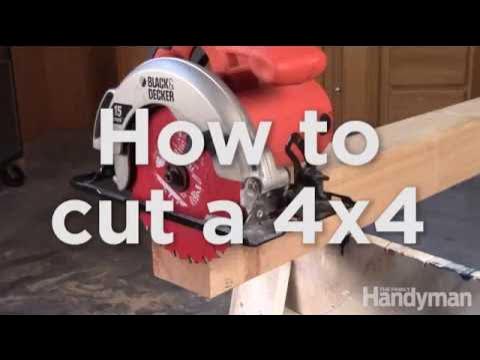
Image Source: i.ytimg.com
Preparing for the Cut: Essential Steps
Before you even think about powering up your circular saw, proper preparation is key. This involves selecting the right blade, setting up your workspace, and understanding the material you’re working with. These initial steps lay the foundation for safe and accurate lumber cutting.
Choosing the Right Blade
The blade you use significantly impacts the quality of your cut. For 4×4 lumber, which is dense hardwood, you need a blade designed for aggressive cuts but also capable of producing a relatively clean finish.
- Tooth Count: Blades with fewer teeth, typically in the 20-24 tooth range, are generally better for ripping (cutting along the grain) and rougher cuts. For crosscutting (cutting across the grain) 4x4s, a blade with 40-50 teeth can provide a cleaner edge. However, for a standard 4×4, a good all-purpose blade with around 40 teeth will often suffice, offering a balance between speed and finish.
- Blade Material: Carbide-tipped blades are the standard for their durability and ability to stay sharp longer than high-speed steel blades.
- Blade Kerf: The kerf is the width of the cut the blade makes. Thinner kerf blades remove less material, requiring less power from your saw and producing less dust. This can be beneficial when cutting through thick 4x4s.
Safety First: Gear and Environment
Power tool safety cannot be stressed enough, especially when working with large lumber and powerful saws. Always prioritize safety.
- Personal Protective Equipment (PPE):
- Safety Glasses: Essential to protect your eyes from sawdust and debris.
- Hearing Protection: Circular saws are loud; earplugs or earmuffs are crucial.
- Dust Mask or Respirator: Sawdust can be harmful to your lungs.
- Work Gloves: Improve grip and protect your hands.
- Sturdy Footwear: Protects your feet from falling material or dropped tools.
- Work Area:
- Clear and Stable: Ensure your workspace is free of clutter and tripping hazards.
- Good Lighting: Proper illumination helps you see your cut line accurately.
- Support for the Lumber: The 4×4 needs to be securely supported on both sides of the cut. Sawhorses or sturdy blocks are ideal. Ensure the offcut piece is also supported so it doesn’t bind the blade or pinch the wood.
Understanding Your 4×4 Lumber
4×4 lumber is actually closer to 3.5 inches by 3.5 inches. This is important to know when planning your cuts and setting up any guides. Different wood types will also have varying densities, affecting how easily the saw cuts through them.
Mastering the Cut: Techniques for Accuracy
Achieving straight cuts on a 4×4 with a circular saw requires a combination of proper technique and the use of guiding aids. While a miter saw alternative can be used, a circular saw offers portability and flexibility.
Blade Depth Setting
This is a critical step often overlooked by beginners. Proper blade depth ensures a clean cut and maximizes safety.
- The Rule of Thumb: Set the blade depth so that the bottom of the teeth extend just slightly below the material being cut. Ideally, this is about 1/8 inch to 1/4 inch below the wood.
- Why it Matters:
- Cleaner Cuts: A blade that’s too deep can cause splintering on the underside of the cut. A shallower depth allows the blade to exit the wood more cleanly.
- Safety: A blade that’s set too low significantly increases the risk of the blade binding or kicking back. A blade that’s too high also presents a greater exposure hazard.
- Blade Efficiency: A correctly set blade cuts more efficiently and puts less strain on the motor.
Making Straight Cuts Without Guides
For simple cuts where extreme precision isn’t paramount, you can freehand the cut. However, this is where practice and a steady hand come into play.
- Mark Your Line: Use a sharp pencil and a quality speed square or combination square to draw a clear and precise line across the 4×4.
- Position the Saw: Align the blade on your circular saw with the cut line. Most circular saws have a guide mark on the base plate that indicates the blade’s kerf.
- Start Smoothly: Ensure the saw is at full speed before contacting the wood.
- Maintain a Steady Pace: Move the saw forward at a consistent speed, allowing the blade to do the work. Forcing the saw will result in a rough cut and can be dangerous.
- Follow Through: Continue the cut completely through the wood.
Utilizing a Circular Saw Guide for Precision
To get consistently straight cuts, using a guide is highly recommended. This is where a circular saw guide comes into play.
The Fence Attachment
Most circular saws come with a rip fence. While useful for narrower cuts, a standard rip fence is often too short to guide effectively along the entire length of a 4×4, especially when starting the cut. However, it can be useful for shorter, guided cuts if the fence can still make contact with the edge of the 4×4.
Creating a Temporary Guide (The “Worm Clamp” Method)
A common and effective method is to clamp a straight piece of material to your 4×4 to act as a guide.
- Select a Straight Edge: Use a known straight piece of wood (like a scrap of 1×4 or a metal level) that is longer than your cut.
- Measure and Mark: Measure the distance from your cut line to the edge of your circular saw’s base plate where the blade is located. Remember to account for the kerf of your blade.
- Clamp the Guide: Align the straight edge with your cut line and clamp it securely to the 4×4. Ensure the clamps do not interfere with the path of the saw. Use sturdy clamps like parallel jaw clamps or C-clamps.
- Test the Fit: Before cutting, place the base plate of your circular saw against the guide to ensure it slides smoothly and the blade is precisely on your marked line.
Using a Commercial Circular Saw Guide Rail
For even greater accuracy and ease of use, commercial guide rail systems are available. These systems provide a perfectly straight surface for your saw’s base to follow, often with specialized clamps. While an investment, they are excellent for repetitive, high-precision cuts.
Advanced Techniques and Tools
For more complex or repeated cuts, consider these advanced techniques and tools. These can transform your circular saw into a more precise lumber cutting tool, rivaling a miter saw alternative in some applications.
The Crosscut Sled
A crosscut sled is a workshop favorite for making perfectly square crosscuts on a table saw, but a simplified version can be adapted for circular saws to achieve similar results. This is a more involved DIY project but yields fantastic accuracy.
How it Works: A crosscut sled for a circular saw typically involves a base plate that rides on the 4×4, with an upright fence that the circular saw’s base is clamped to. This whole assembly then slides along the 4×4, ensuring the saw moves perfectly straight.
Building a Simple Crosscut Jig for a Circular Saw:
- Base Plate: Use a large, flat piece of plywood (e.g., 3/4 inch thick). It needs to be larger than your 4×4 and the base of your circular saw.
- Guide Strip: Attach a straight strip of wood (like a 1×2) to the edge of the base plate. This strip will ride along the edge of your 4×4.
- Fence: Attach a perpendicular fence to the base plate. The circular saw will be clamped to this fence.
- Clamping the Saw: Use pipe clamps or specific jig clamps to secure the circular saw to the fence. Ensure the blade aligns perfectly with the edge of the guide strip.
- Making the Cut: Lay the 4×4 on sawhorses. Place the crosscut sled over the 4×4, with the guide strip running along the edge. Clamp the sled in place. Make your cut by sliding the saw and sled assembly along the 4×4.
Wood Cutting Jig for Angled Cuts
While this guide focuses on straight cuts, a wood cutting jig can also be made to assist with angled cuts if needed. These jigs often involve a pivot point and a way to set the angle, guiding the saw along that predetermined line.
Troubleshooting and Pro Tips
Even with the best preparation, you might encounter issues. Here are some common problems and pro tips to overcome them.
Dealing with Splintering
Splintering is common, especially on the exit side of the cut.
- Score the Line: Lightly score the cut line with a utility knife before sawing.
- Painter’s Tape: Apply a strip of painter’s tape along the cut line. Saw through the tape, which helps hold the wood fibers together.
- Blade Choice: As mentioned, a higher tooth count blade for crosscutting can reduce splintering.
- Blade Depth: Ensure your blade depth is set correctly.
Preventing Kickback
Kickback is a dangerous phenomenon where the saw is violently thrown back towards the operator. It’s often caused by the blade binding in the cut.
- Support the Material: Make sure the 4×4 is well-supported and the offcut piece doesn’t fall and pinch the blade.
- Blade Condition: Use sharp, well-maintained blades. Dull blades require more force and are more prone to binding.
- Avoid Twisting: Never twist the saw in the cut. Keep it moving in a straight line.
- Proper Stance: Maintain a balanced stance that allows you to control the saw.
- Blade Guard: Never disable or remove the blade guard.
Maintaining a Straight Cut Over Long Distances
For long 4x4s, keeping the cut perfectly straight can be challenging.
- Use a Longer Guide: If using the temporary guide method, use a longer straight edge that extends well beyond the cut area.
- Consider a Circular Saw Guide Rail System: These systems are designed for longer, straighter cuts.
- Two-Person Operation: For very long pieces, having one person guide the saw and another stabilize the lumber can be beneficial, but ensure clear communication and coordinated movements.
Making Multiple Identical Cuts
If you need to make many identical cuts on 4×4 lumber:
- Set Up a Stop Block: Clamp a piece of wood to your workbench or sawhorses. Position the 4×4 so it butts up against the stop block at your desired cut length. Make the cut. For subsequent cuts, simply butt each new 4×4 against the same stop block. This is far more accurate than measuring each time.
When a Circular Saw Might Not Be the Best Choice
While a circular saw is versatile, there are times when other tools might be more suitable for cutting 4x4s.
- High Volume of Precise Cuts: If you have dozens or hundreds of identical, perfectly square cuts to make, a powered miter saw (chop saw) is significantly faster and often more accurate out of the box.
- Need for Perfect Squareness Repeatedly: Achieving a perfectly square cut on a long 4×4 with a handheld circular saw, even with guides, can be more challenging than with a miter saw that has a built-in fence and adjustable stops.
- Limited Workspace: If you have very little space, a miter saw, especially a sliding miter saw, can sometimes be more manageable than setting up extensive guides for a circular saw.
However, for portability, on-site work, or when a miter saw isn’t available, the circular saw remains an excellent option.
Frequently Asked Questions (FAQ)
Q1: Can I cut a 4×4 beam completely through with a standard circular saw blade?
A1: Yes, most standard circular saw blades (7 1/4 inch or 8 inch) are designed to cut through a 3.5-inch thick 4×4. Ensure your blade has enough cutting depth and is sharp.
Q2: What is the best type of circular saw for cutting 4x4s?
A2: A powerful corded circular saw is generally preferred for cutting dense 4×4 lumber, as it provides consistent power. Cordless saws can work, but ensure you have a high-capacity battery and consider that they might bog down more easily on tough cuts.
Q3: How do I ensure my cut is perfectly square on a 4×4?
A3: Use a speed square or combination square to mark your line. Employing a circular saw guide or a DIY crosscut sled is the most reliable way to ensure squareness, especially for repeated cuts.
Q4: What’s the difference between crosscutting and ripping a 4×4?
A4: Crosscutting is cutting across the grain of the wood (the shorter dimension), while ripping is cutting along the grain (the longer dimension). The techniques and sometimes blade choices might differ slightly. For 4x4s, crosscutting is more common.
Q5: How do I prevent the wood from moving during the cut?
A5: Secure the 4×4 firmly to sawhorses or a workbench using clamps. Ensure the offcut piece is also supported to prevent it from falling and binding the blade.
By following these detailed steps and employing the pro tips, you can confidently and accurately cut your 4×4 lumber with a circular saw, tackling your projects with precision and safety.