
What is an AFCI circuit breaker, and how does it work? An AFCI circuit breaker, or Arc-Fault Circuit Interrupter, is a specialized electrical device designed to protect against fires caused by electrical arcs in residential wiring. Unlike standard circuit breakers that primarily safeguard against overloads and short circuits, AFCI breakers detect and interrupt dangerous arc faults, a common cause of electrical fires.
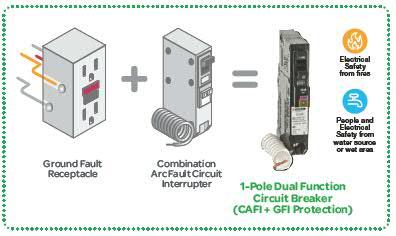
Image Source: www.jadelearning.com
The Growing Need for AFCI Protection
Home electrical systems are becoming more complex, powering more devices than ever before. This increased demand puts a strain on older wiring and can lead to issues that a traditional circuit breaker might miss. Fires caused by electrical faults are a serious concern, and the National Electrical Code (NEC) has progressively mandated AFCI protection in various areas of new homes to enhance electrical safety. Understanding the breaker function and how AFCI technology contributes to residential wiring safety is crucial for homeowners and electricians alike.
What Exactly is an Arc Fault?
Before diving into how AFCI breakers work, it’s essential to grasp what an arc fault is. An arc fault is an unintended electrical discharge or spark that occurs when electricity jumps across a gap in a damaged or deteriorated circuit. This can happen for several reasons:
- Damaged Wires: Worn insulation, pinched wires, or nicked conductors can expose the metal, allowing electricity to arc to another conductor or ground.
- Loose Connections: Wires that are not securely fastened in outlets, switches, or junction boxes can create poor contact points. Over time, these loose connections can overheat and spark.
- Cord Damage: Frayed power cords, pinched appliance cords under furniture, or damaged extension cords are common culprits for creating arc faults.
- Age and Deterioration: Over many years, the insulation on wires can become brittle and crack, creating pathways for arcs.
- Faulty Appliances: Internal wiring failures within appliances can also generate arc faults.
The Dangers of Arc Faults
Arc faults are incredibly dangerous because they generate intense heat. This heat can easily ignite nearby combustible materials like wood framing, insulation, dust, or even furniture. Unlike a short circuit, which typically draws a very large fault current and immediately trips a standard breaker, an arc fault might occur with a much lower current, potentially not enough to trigger a conventional breaker but still sufficient to cause a fire. These “low current” arcs can smolder for extended periods before igniting a blaze, making them particularly insidious.
How Standard Circuit Breakers Work (A Brief Comparison)
To appreciate the unique role of AFCI breakers, it’s helpful to contrast them with standard thermal-magnetic circuit breakers.
- Overload Protection: When too many devices are plugged into a circuit, or a faulty appliance draws excessive current, the wires can overheat. A standard breaker has a thermal element (often a bimetallic strip) that heats up with the current. If the current exceeds a safe limit for a prolonged period, the strip bends and trips the breaker, opening the circuit.
- Short Circuit Protection: A short circuit occurs when a hot wire directly touches a neutral wire or the ground. This creates a very low resistance path, resulting in a massive surge of fault current. A standard breaker uses a magnetic element that instantly reacts to this high current surge, tripping the breaker and interrupting the flow of electricity almost instantaneously.
While effective against overloads and short circuits, standard breakers are not designed to detect the specific electrical signatures of arc faults, which are characterized by their irregular and transient nature.
Deciphering the Mechanism: How AFCI Breakers Detect Arc Faults
The core of an AFCI breaker’s functionality lies in its sophisticated electronic circuitry, which is designed for arc-fault detection. These breakers are not simply sensing the amount of current; they are actively analyzing the electrical waveform for specific patterns that indicate the presence of an arc.
The Electronic Brain of the AFCI
Inside an AFCI breaker, a microelectronic chip acts as the “brain.” This chip constantly monitors the electrical current flowing through the circuit. It’s programmed to recognize the unique “fingerprint” of an arcing event. What does this fingerprint look like?
- Rapid Current Fluctuations: An arc fault is not a steady flow of electricity. Instead, it’s characterized by rapid, irregular on-and-off cycles of current as the electricity jumps across the gap. This creates a choppy, erratic waveform.
- Radio Frequency Noise: The rapid switching and ionization of air during an arc generate high-frequency radio waves. The AFCI circuitry can detect this characteristic radio frequency interference (RFI).
- Harmonics: Arcing can also introduce specific harmonic distortions into the electrical signal. The AFCI analyzes these harmonic patterns.
Two Main Types of Arc Faults and Their Detection
AFCI breakers are designed to detect two primary types of arc faults:
- Series Arc Faults: These occur when there is an break in a single conductor within a circuit, for example, a damaged wire where the circuit is still complete via another path. The arc jumps between the two ends of the broken conductor. The electronic circuitry in an AFCI breaker detects the characteristic intermittent current interruptions and associated noise.
- Parallel Arc Faults: These occur when a hot wire arcs to a neutral wire or to ground. This creates a much larger surge of current, similar to a short circuit, but with the distinct arcing signature. While a standard breaker might eventually trip due to the increased current, an AFCI can detect the arc much earlier and more reliably.
The Detection Process in Action
- Continuous Monitoring: The AFCI breaker continuously samples the current waveform on the circuit.
- Pattern Recognition: The internal microchip analyzes this waveform for the specific signatures of an arc fault – the rapid fluctuations, the RFI, and the harmonic distortions.
- Distinguishing Arcs from Normal Operations: A critical challenge for AFCI technology is differentiating between dangerous arc faults and normal electrical “noise” generated by everyday appliances like fluorescent lights, dimmer switches, or even brush-type motors in vacuums or blenders. AFCI breakers are sophisticated enough to learn and distinguish between these. They are programmed to look for the specific characteristics that are exclusive to dangerous arcs.
- Circuit Interruption: If the microchip identifies a pattern consistent with a dangerous arc fault, it triggers the breaker’s internal mechanism to open the circuit, instantly stopping the flow of electricity and preventing a potential fire. This circuit interruption is the ultimate goal.
Advanced AFCI Technologies: Dual-Function Breakers
The evolution of AFCI technology has led to dual-function breakers, which combine AFCI protection with Ground Fault Circuit Interrupter (GFCI) protection.
- GFCI Protection: GFCIs protect against electrical shock hazards by detecting small imbalances in current between the hot and neutral wires. If the current going out doesn’t match the current coming back, it indicates current is leaking to ground, potentially through a person, and the GFCI trips.
- Dual-Function Breakers: These breakers offer both arc-fault and ground-fault protection in a single unit, providing a comprehensive layer of safety for home electrical systems. This is particularly useful in kitchens, bathrooms, and laundry areas where both shock and fire hazards are present.
Where AFCI Protection is Required by the National Electrical Code
The National Electrical Code (NEC), a set of standards for safe electrical design and installation, has expanded its requirements for AFCI protection over the years. As of recent editions, AFCI protection is generally required in:
- All required outlets in dwelling units.
- Bedrooms: Including circuits supplying outlets and lighting.
- Living Areas: Such as living rooms, dining rooms, family rooms, parlors, libraries, dens, hallways, and recreation rooms.
- Kitchens: Including receptacles and lighting circuits.
- Dining Rooms: Similar to living areas.
- Bathrooms: To protect against shock and fire.
- Laundry Areas: Where water and electricity can be a hazardous mix.
- Closets: For clothes closets, to prevent ignition of stored materials.
- Stairways: Circuits supplying lighting and potentially outlets.
- Garages: And unfinished basements, to mitigate fire risks in areas often containing flammable materials.
These requirements reflect the growing awareness of the prevalence and danger of arc faults in residential wiring.
Installing and Testing AFCI Breakers
Installing AFCI breakers is similar to installing standard breakers but requires careful attention to wiring and labeling.
Installation Considerations
- Correct Type: Ensure you are using the correct AFCI breaker for the specific circuit and load.
- Wiring: Follow wiring diagrams precisely. The breaker’s load terminals connect to the circuit’s hot and neutral wires. The ground wire connects to the ground bar in the panel.
- Neutral Connection: AFCI breakers require a connection to the neutral wire of the circuit, which is a key difference from some older GFCI designs. This is necessary for the electronic monitoring circuitry to function correctly.
- Labeling: Clearly label the AFCI breaker in the electrical panel so its function is easily identifiable.
Testing for Proper Functionality
AFCI breakers have a “Test” button on the front. Regular testing is essential to ensure the arc-fault detection and circuit interruption mechanisms are working correctly.
- Monthly Testing: It is recommended to test AFCI breakers monthly.
- How to Test: Simply press the “Test” button. This should simulate an arc fault, causing the breaker to trip. If it doesn’t trip, the breaker may be faulty and needs replacement.
- Resetting: After testing, reset the breaker by pushing the handle fully to the “Off” position and then back to the “On” position.
Benefits of AFCI Protection
The primary benefit of AFCI protection is significantly enhanced electrical safety in the home.
- Fire Prevention: By detecting and interrupting arc faults, AFCI breakers are highly effective at preventing electrical fires, a leading cause of house fires.
- Protection Against Subtle Faults: They can detect arc faults that might go unnoticed by standard breakers, protecting against the insidious dangers of smoldering electrical issues.
- Compliance with Codes: Using AFCI breakers ensures compliance with modern electrical codes, which are designed to protect occupants and property.
- Peace of Mind: Knowing that your home electrical systems are protected by advanced technology offers significant peace of mind.
Potential Challenges and Considerations
While highly beneficial, there are a few considerations when using AFCI breakers:
- “Nuisance Tripping”: Early AFCI technology could sometimes be overly sensitive, leading to “nuisance tripping” from harmless electrical events. Modern AFCI breakers have improved significantly in their ability to distinguish between dangerous arcs and normal electrical noise. However, in some older homes with less sophisticated wiring or specific types of appliances, occasional nuisance tripping might still occur.
- Cost: AFCI breakers are generally more expensive than standard breakers. However, the increased safety they provide often justifies the additional cost.
- Compatibility: It’s important to ensure that the AFCI breaker is compatible with your electrical panel.
AFCI Breaker Functionality Summary
| Feature | Standard Breaker | AFCI Breaker |
|---|---|---|
| Primary Protection | Overcurrent (overloads and short circuits) | Arc faults, overcurrent (depending on type) |
| Detection Method | Thermal (overload), Magnetic (short circuit) | Electronic circuitry analyzing waveform for arc signatures (fluctuations, RFI) |
| Sensitive to | Excessive current | Specific electrical waveform patterns indicative of arcs |
| Breaker Function | Protects against wire overheating and immediate shorts | Protects against fires caused by arcing faults, common in damaged wiring |
| Arc-Fault Detection | No | Yes |
| Circuit Interruption | Yes, for overloads and short circuits | Yes, for arc faults and potentially overcurrents |
| Electrical Safety | Basic safety | Enhanced safety, especially against fire hazards |
| Residential Wiring | Standard protection | Critical protection for modern residential wiring |
| National Electrical Code | Often required | Mandated in many areas of new construction and renovations |
| Fault Current | Trips on high fault current | Trips on specific arc signatures, which may or may not involve high fault current |
Frequently Asked Questions (FAQ)
Q1: Can I replace a standard circuit breaker with an AFCI breaker myself?
A1: While the physical installation might seem similar, it’s generally recommended to have a qualified electrician install or replace circuit breakers. They can ensure the correct breaker is used, the wiring is done properly, and that the AFCI breaker is compatible with your electrical panel. Improper installation can be dangerous.
Q2: Do AFCI breakers protect against electrocution?
A2: AFCI breakers primarily protect against fires caused by arc faults. For protection against electrocution (electrical shock), Ground Fault Circuit Interrupters (GFCIs) are designed. Dual-function breakers combine both AFCI and GFCI protection.
Q3: My AFCI breaker keeps tripping. What should I do?
A3: If an AFCI breaker is tripping repeatedly, it indicates a potential problem. First, try to identify if a specific appliance or activity triggers the trip. If the tripping is persistent or occurs randomly, it’s crucial to have a qualified electrician inspect your home electrical systems and the AFCI breaker itself to diagnose the issue. It could be a true arc fault, a fault in an appliance, or a problem with the breaker.
Q4: Are AFCI breakers required in older homes?
A4: The National Electrical Code typically mandates AFCI protection for new construction and major renovations. While not always retroactively required for older homes unless work is being done in specific areas, it is strongly recommended by fire safety organizations and electrical experts to upgrade to AFCI protection for improved electrical safety, especially in bedrooms and living areas.
Q5: What is the difference between a single-pole and a double-pole AFCI breaker?
A5: A single-pole AFCI breaker protects a single 120-volt circuit, typically used for standard lighting and outlets. A double-pole AFCI breaker protects a 240-volt circuit (like those for electric dryers, water heaters, or central air conditioners) and has two handle ties to ensure both poles trip simultaneously.
Q6: How do AFCI breakers detect different types of arc faults?
A6: AFCI breakers use sophisticated electronics to analyze the electrical waveform for characteristics that are unique to arc faults. This includes looking for rapid, intermittent current fluctuations, high-frequency noise (RFI), and harmonic distortions in the current. They are programmed to distinguish these signatures from normal operational electrical noise generated by various appliances.
Q7: Can an AFCI breaker detect a loose wire in a light fixture?
A7: Yes, if a loose wire in a light fixture causes an arc fault, an AFCI breaker is designed to detect the specific electrical signature of that arc and trip the circuit. This is a common scenario where AFCI protection provides crucial fire prevention.
Q8: What is the lifespan of an AFCI breaker?
A8: Like standard circuit breakers, AFCI breakers have a long lifespan, often 20-30 years or more. However, their electronic components can degrade over time, and they should be tested regularly (monthly) to ensure they are functioning correctly. If a breaker fails its test or begins tripping erratically, it should be replaced.
The information provided in this blog post aims to offer a comprehensive overview of AFCI circuit breakers, their operation, and their vital role in modern electrical safety. Always consult with a qualified electrician for any electrical work in your home.